


Late Spring Folk Festival: grassroots and community
Updated: Jun 4
Words by Josh Hart
Folk music is in an interesting place. From the folk clubs sprouting across London, to the acts that are taking the genre forward, there is a palpable craving for folk culture – whether it is songs, spells, or traditions that carve a path to our collective past. The Late Spring Folk Festival, which was started in 2022 by members of the Wiltshire folk band Dead Pages, captures this reverence. Beginning as a free event at a pub, it has since blossomed to a nearly one-thousand capacity one-day event on a farm and brewery in Hampshire. It’s truly grassroots – with friends and artists helping to make the day a success. It felt like the lineup, including folk artists playing alongside country, indie, and Americana acts, as well as rising singer-songwriters, demonstrated the wide influence of folk music. With this in mind, I was excited to see what the music had to say.

Upon entering the festival, I’m met with a small ticket desk – a far cry from walled inner-London festivals. Walking from the brewery barns into the main arena, I was surrounded by hay bales, folk workshops and crafts rents, food stalls, mental health goats, and even a DIY zine stall operated by @zinebox.london. It felt laidback, and surprisingly wholesome. Speaking to a zinebox operator, explaining there is a return to zine culture as “a response to the digital age … people getting overwhelmed with AI and digital content. People are definitely getting more and more into physical media” – it felt like a table of zines fit perfectly at an event that focused on grassroots, DIY culture.

Thomaz Martin brought rock n’ roll to the Garden Stage in one of the first acts of the day. Punctuated by growling guitar solos, his set moved between swagger and sincerity, giving an intensity to the smooth folk-rock of singles from upcoming debut album Nostalgia For Modern Times. I chatted later with Thomaz, getting his thoughts on folk and his place within the lineup. He told me, “Folk music is originally the music of the people. It's changed its shape and forms, but rock music is still very much folk music; a way for people to express themselves. There’s a reason that Bob Dylan played the 1964 Newport Folk Festival on the Stratocaster, and it says a lot to what he thought folk music was at the time. We’re now so privileged in the way that the music of the people has expanded to include so many forms of sound, shapes and colours, so I feel like we fit perfectly here. We’re all still playing the music of the people.”
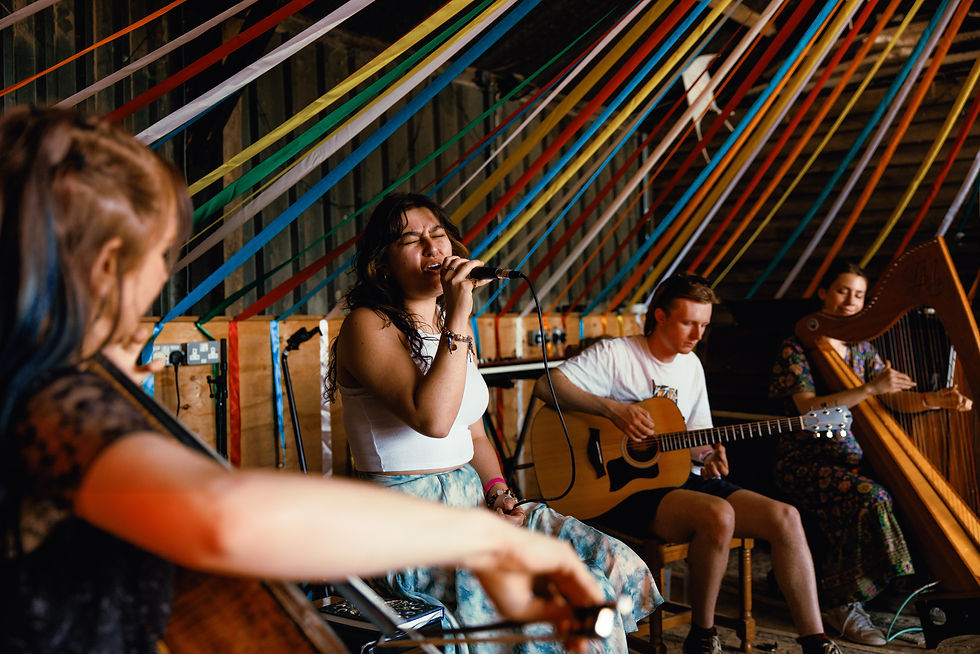
At the aptly-named Barn Stage, decked out in benches and sofas, I caught London-based alternative folk quartet Lydia Laughing. Inspired by dream pop as well as folk singer-songwriters, their songs felt contemporary while drawing from folk music from the members' respective backgrounds of Scotland, Turkey, Dorset, and Kent. Chatting to the band later about what brought them together as a band, guitarist James Rampton explained “We wanted to get as much as we could from playing together. We all play as professionals in separate projects, and we wanted something to become attached to; to put our creative desires into. We gravitated towards folk music because, in a general sense, it’s about togetherness.” Singer Seda Baysal added, “You get to be very sincere, and put all your emotions in there […] Before this project, I never really dove into Turkish music, so it’s fun to take their harmonies and melodic choices and weave it into our music. There are dream pop influences [in our music], and the strong structures are very pop influenced.”

In the warm glow of the afternoon, Natalie Wildgoose’s hypnagogic folk was realised at the Barn Stage. Supported by a guitarist and backing vocalist, their performance captured all of the warmth of the four-track recordings of recent EP Rural Hours. Speaking to the intimacy of the setting, Natalie Wildgoose explained “it feels a little bit like a living room – with the sofas. It didn’t feel too dissimilar from where some of the stuff was recorded, so it felt very comforting.” Asking about what folk music means to her, she tells me “I grew up playing lots of different genres, but it’s definitely the biggest influence on the music I write.” Headliner Jon Wilks brought a sense of folk canon to the festival. Performing traditional tracks, self-written songs, and covering Martin Carthy, a dear friend and collaborator, the entire Garden Tent was in bliss. Incredibly modest, he even ushered the audience to see Olivia Chaney, who was to begin soon.

Olivia Chaney’s set at the Barn Stage was easily one of the most-awaited. She moved masterfully between harmonium, piano and guitar across an incredible set that included a touching cover of Judee Sill’s ‘The Kiss’. Chatting to her about the festival, and the increasing interest in folk music, Olivia shares that “It feels like everyone’s come with an open mind […] there is this movement, this kind of rumbling, and it feels like this festival is harnessing that.” Her final song, ‘Dark Eyed Sailor’ had a crossover moment this year, appearing in Emerald Fennells’s “Wuthering Heights”. Asking her about its recent success, she says that people have reached out so many times on Instagram to say how much the song has affected them and how it has gotten them into folk music. She also mentions that after today’s performance, a man came up to her and said he wasn’t a folk music fan, but hearing ‘Dark Eyed Sailor’ today was one of the most beautiful moments in his life. I found him later on, and he told me first-hand how watching her performance of the song reminded him of his Irish mother, and was the first time that music had truly affected him so deeply, and emotionally, in a lifetime of listening to (primarily, rock) music. It was an incredibly powerful experience to hear about – speaking to music’s ability to connect people, and the importance of festivals.

On after were The Ocelots, who brought their wonderful harmonies and country-influenced ballads to the Barn Stage. The Pegwells' Appalachian folk had people moved, and moving. It was fitting that the Folk Club Ceilidhe followed, led by Annie Walton of Lydia Laughing. One of the most well-attended moments of the event – sofas and benches pushed to the side, it was a literal barn dance. British-Chilean singer-songwriter Naomi In Blue’s commanding, sorrowful vocals rang through the Garden Tent – performing striking glimpses of debut Is this body mine? – recorded with festival founder and producer Gus White and releasing on Man Made Tigers this Autumn. Dill Chatter’s mix of driven country and laidback folk, with minimal online presence to precede it, was refreshing to see how much it resonated with the crowd. Les Caravanes, the “travelling folk club”-cum-band, delivered a stellar set that included recent single ‘Black Leg Miner’ and a pirate folk song from Hampshire. For a moment, this felt like pirate post-rock, as trad-folk vocals glided over droning textures.

Sweet Giant closed out the Garden Stage – their desert-inspired indie rock capturing the crowded tent. Playing in an alternate lineup, and with only two days practice, it didn’t show in their performance. Annie Needham, singer of the band and an organiser of the festival, had herself played in multiple bands across the day – and her own set was no less collaborative. Bringing on London-based freak-country singer Esme White for a cover of Tom Waits, followed by folk artist Ann Liu Cannon – eventually, a host of friends, including the festival founders, took to the stage, dancing and singing away for the rest of the set. In this moment, I felt a witness of a scene, and a community, celebrating what they had built.

After this, everyone rushed off to the Barn Stage to catch the final act, Alan Power & the Take Two’s, who played their country into the night. Chatting to the organisers later, I was told, “all our dreams were realised…I was blown away by how strong the core community behind this festival is; how it’s growing, and becoming ever more beautiful year on year” and that “this was exemplified by Sweet Giant’s set when we all got on stage and rocked out together”. Leaving the event, I was struck by the sense of community at the core of the festival. The passion for community-based, grassroots music is only growing, and, hopefully, the Late Spring Folk Festival will grow with it.


Comments